Ozone Days and the Air You Pull Inside
On an ozone action day in Denver, the gas builds outdoors in hot sun, so pull outdoor air in during the cool morning and evening, close up through the afternoon, and don't expect a furnace filter to catch it.
By the editors of Heating & Cooling the Front Range · Sources checked
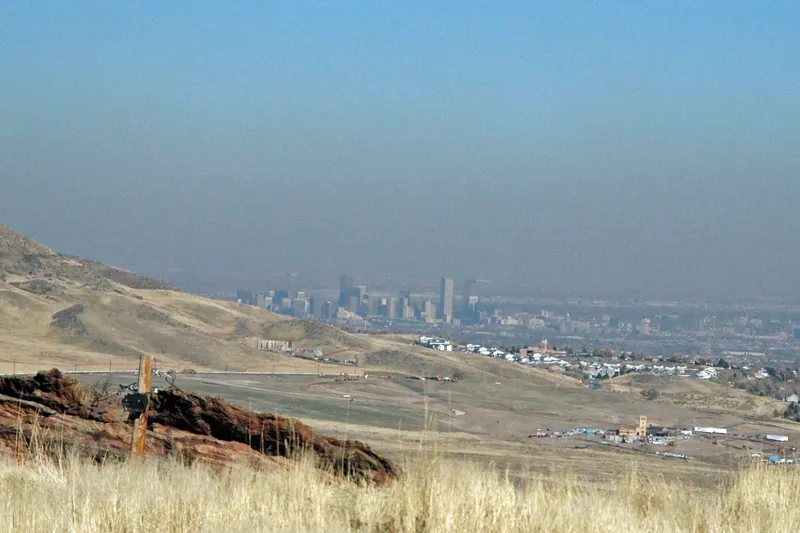
Ozone days rarely look dramatic. The sky over the city is a pale, washed-out blue, the foothills a little softer than usual, and the afternoon is hot and still. There is no orange sun and no smell of burning, nothing like a smoke day. Then the phone shows an Ozone Action Day Alert, and the question for anyone with a swamp cooler or a habit of opening windows is what that means for the air indoors.
The answer turns on one fact: ozone is a gas that forms outdoors in sunshine. Anything that pulls outdoor air into the house, whether a roof cooler, a box fan in a window or an open door, pulls in whatever ozone is out there. Filters built for dust and smoke particles do little or nothing about it.
So the playbook for ozone days is mostly about timing. Use outdoor air when it is cool and the sun is low, close the house up through the hot middle of the day, and lean on recirculating systems if you have them. Here is why that works, and what it means for each kind of cooling a Front Range house might have.
Part 1What is ozone, and why does it build on hot days?
Ground-level ozone is not something any chimney or tailpipe emits directly. The Regional Air Quality Council's ozone page describes it as a secondary pollutant that forms when hydrocarbons and nitrogen oxides combine in the presence of sunlight. A cloudless Front Range summer supplies plenty of the light.
That is why ozone tracks the weather. EPA's health effects page says ozone can reach unhealthy levels especially on hot, sunny days. It names the people most at risk: those with asthma, children, older adults and anyone active outdoors.
The state's air quality advisory page runs a summer Ozone Action Day Alert program and gives a clear piece of advice for alert days: avoid rigorous outdoor activity during the heat of the day. Alerts can also be issued at other times of year when needed, but summer ozone season is when they cluster.
Part 2Why does the Front Range keep getting alerts?
The Denver Metro and North Front Range area has repeatedly missed federal ozone attainment dates. Under the 2008 ozone standard, EPA's 2025 proposed rule describes the region as Severe nonattainment, a step it reached in 2022 after first being moved up to Serious. Under the stricter 2015 standard, the Regional Air Quality Council reports that EPA finalized a reclassification to Serious on July 24, 2024.
For a homeowner, those labels mostly translate into a familiar summer pattern: clear, hot afternoons when ozone climbs and the alert goes out. They also explain why the advisory system exists at all. It is a warning, above all, to anyone whose lungs react to ozone.
Part 3The swamp cooler problem
An evaporative cooler is, in effect, a large fan that draws outdoor air through wet pads and blows it through the house. DOE's page on evaporative coolers describes it as a steady stream of fresh air, which is usually a selling point. On an ozone day it is the weak spot. The pads cool and moisten the air, but nothing in the cooler is designed to take ozone out of it.
Filters will not rescue this either. EPA's MERV explainer describes MERV ratings in terms of particles between 0.3 and 10 microns. Ozone is a gas, so a filter's MERV number says nothing about ozone. The 4-inch MERV 13 filters that EPA describes for covering cooler intakes on smoky days are a smoke measure, not an ozone one.
The practical answer is to use the cooler when the outdoor air is at its best. Run it hard in the morning while the air is still cool and the sun is low, ease off or switch it off through the hot afternoon, and bring it back in the evening as the day cools. For a household with asthma, a child who reacts to bad-air days or an older relative with weak lungs, lean further toward the off side on alert afternoons. Keeping the unit itself in good order, spring and fall, is the subject of our cooler opening and closing guide.
Part 4Windows, box fans and the night air
The Front Range has a gift for this kind of schedule: cool nights. NOAA's 1991–2020 normals at Denver International Airport give a July low of 60.2°F against a high of 89.9°F, close to a 30-degree swing between dawn and late afternoon. The Colorado Climate Center notes that Colorado sees large day-to-night temperature changes, and a house can bank a lot of that overnight cool.
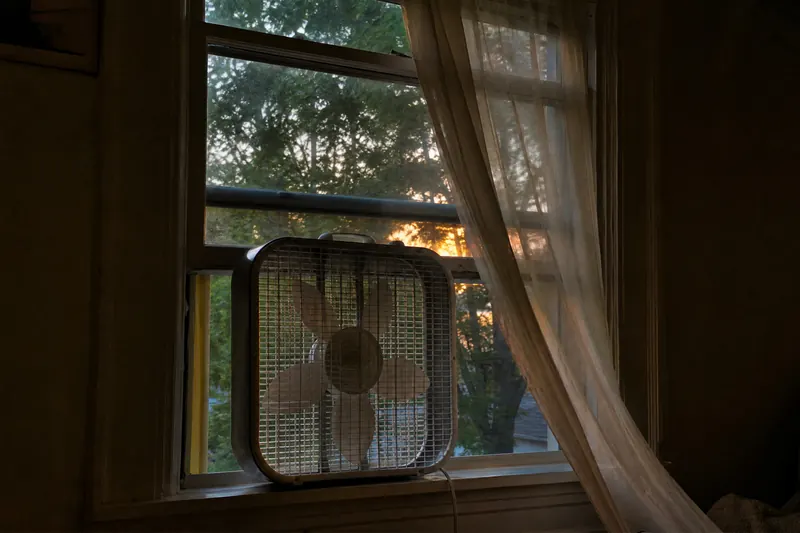
On an ozone day, that means opening windows and running a window fan through the evening and early morning, then closing windows and drawing blinds on the sunny side before the day heats up. The house coasts through the afternoon on the cool it collected overnight, with less outdoor air coming in just when ozone is building. It is the same logic EPA applies to smoke: let outdoor air in when it is at its best, and keep it out when it is at its worst.
Part 5Central air and heat pumps on alert afternoons
Central air conditioners and heat pumps recirculate the same indoor air, which puts them at an advantage on ozone days. Keep the windows shut and let the system run. Where a system includes an outdoor-air intake or a ventilation fan, learn how it is set; EPA's wildfire guidance describes switching such systems to recirculate or closing the outdoor damper, and the same move cuts how much outdoor air is drawn in on an ozone afternoon.
If a window air conditioner has an outdoor air damper, keep it closed on alert days. Houses that rely on both a roof cooler and central air can switch to the central system through the afternoon and back to the cooler in the evening. Whether that flexibility justifies the cost is weighed in our comparison of swamp coolers and central air, and our heat pump and furnace piece covers the heating side of the same equipment.
Part 6Air cleaners that make ozone
Some air cleaners are sold on the promise that ozone freshens or purifies indoor air. EPA's page on ozone generators sold as air cleaners is blunt: "ozone is generally ineffective in controlling indoor air pollution." The same page notes that relatively low amounts of ozone can cause chest pain, coughing, shortness of breath and throat irritation. On a day when outdoor ozone is already high, adding more indoors makes no sense. If the box or listing for an air cleaner doesn't say plainly that it makes no ozone, ask the seller before you buy, or pick a different model.
The same caution applies to ionizers and other cleaners that make ozone as a by-product. Before buying any room cleaner, check the label and the maker's specifications for ozone output; EPA's wildfire guidance points buyers to cleaners that emit none. A filter-based cleaner is the safer choice for smoke and dust, though its particle filter is not built to deal with ozone.
Part 7When smoke and ozone arrive together
Late summer can bring both on the same day: smoke drifting in from fires to the west, and ozone building under a hot sun. The two call for slightly different tools. Smoke is mostly fine particles, which a MERV 13 furnace filter and a portable cleaner can catch. Ozone is a gas, which particle filters are not designed to catch.
The overlap is the swamp cooler. On a smoky day it should be off, or barely used, unless every outside intake is covered with 4-inch MERV 13 filters; on an ozone afternoon it should be eased back regardless. With both in the air, keep the windows shut, run any central system on recirculate with the fan on and a good filter in place, and use the cool, clearer evening hours to air the house out if the smoke allows. Our wildfire smoke and filter guide has the full smoke routine, and our piece on hot upstairs rooms helps if closing up the house leaves the second floor stuffy.
Common questions
Where are Denver's Ozone Action Day Alerts posted?
The state posts alerts through its air quality advisory page during the summer program. AirNow also reports the AQI for the area, where values at or below 100 are generally considered satisfactory.
Should the swamp cooler run at night on an ozone alert day?
Evenings and nights are the better time to run it, because ozone builds in hot sunshine and the state's advice targets the heat of the day. Ease it back through the afternoon, especially if anyone at home has asthma.
Does a MERV 13 filter remove ozone?
No. MERV ratings describe how well a filter traps particles, and ozone is a gas. A good filter still helps with smoke and dust, but it is not an ozone fix.
Is indoor exercise fine with the windows open on an ozone day?
The state's alert advice is to avoid rigorous outdoor activity during the heat of the day. With the windows wide open in the afternoon, outdoor air is coming straight in, so close up or move the workout to the morning or evening.
Does an ozone purifier help on alert days?
EPA does not recommend ozone generators; it says ozone is generally ineffective at cleaning indoor air and can harm the lungs. Closing up through the afternoon and using outdoor air early and late is the practical approach.
Sources
- Regional Air Quality Council — Ozone — how ground-level ozone forms
- Regional Air Quality Council — SIP, Ozone 2015 8-hour standard — Serious classification since July 24, 2024
- Federal Register — EPA proposed rule 2025-07937 — Severe nonattainment under the 2008 standard
- EPA — Health Effects of Ozone Pollution — hot sunny days, who is most at risk, symptoms
- Colorado air quality advisories — Ozone Action Day Alert program and activity advice
- EPA — Ozone generators marketed for cleaning indoor air — ozone generators ineffective and harmful; typical indoor ozone from outdoors
- EPA — What is a MERV rating? — MERV describes particle capture
- DOE Energy Saver — Evaporative Coolers — steady stream of outdoor air
- NOAA NCEI — Denver Local Climatological Data, 2023 — July normal low and high
- Colorado Climate Center — Climate of Colorado — large day-to-night temperature changes
- EPA — Wildfires and Indoor Air Quality — recirculate mode, outdoor dampers, no-ozone air cleaners