Furnace, Heat Pump or Both?
Furnace or heat pump in Colorado is rarely all-or-nothing. A cold-climate heat pump can carry most Front Range winter days; a gas furnace or backup heat covers the hardest nights. Prices, rebates and your ducts decide the mix.
By the editors of Heating & Cooling the Front Range · Sources checked
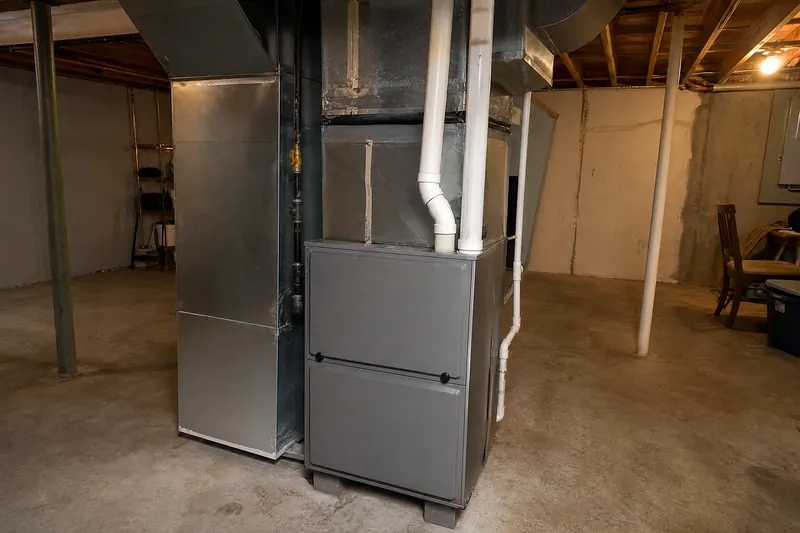
It is a January morning in Arvada and the thermometer on the back porch reads single digits. By two in the afternoon a chinook has come down off the foothills, the snow on the south-facing roofs is dripping, and the same porch is warm enough for shirtsleeves. The furnace in the basement ran hard at dawn and has barely fired since lunch. That one day holds most of the argument about how to heat a house here.
For decades the Front Range answer was a gas furnace in the basement, ducts to every room, and a separate air conditioner or a rooftop swamp cooler for summer. When those furnaces wear out now, the replacement question has a third answer that once seemed out of place in a Colorado winter.
That answer is the heat pump: the same machine as an air conditioner, run in reverse in winter to pull heat out of cold outdoor air. In short, a well-chosen cold-climate heat pump can handle most of the hours a Denver-area house needs heat, the coldest nights are where a gas furnace or electric backup earns its keep, and many households will end up with both. The details depend on your house, your ducts, gas and electric prices, and rebates with firm end dates.
Part 1What kind of winter does a Denver house actually have?
The Front Range winter is long but uneven. NOAA's 1991–2020 normals for Denver International Airport put the year at 5,863 heating degree days against 849 cooling degree days, so a house here needs far more heating than cooling over a year. That alone says the heating choice matters more to the energy bill than the air conditioner does.
But the cold comes in bursts. The Colorado Climate Center notes that temperature rises of 25 to 35°F in a short time are not uncommon when a chinook arrives, and that these winds greatly moderate average winter temperatures near the mountains. An arctic front can hold the metro area near zero for a few days; then the wind turns west and the next week feels like March. Most heating hours here are mild cold, with a handful of truly deep ones.
That pattern suits a heat pump, which is at its most efficient when the outdoor air is cool rather than frigid. The deep-cold mornings are where the design has to be right.
Heating vs cooling need at DIA
degree days a year
Part 2How does a heat pump cope when it is 5°F outside?
The old worry about heat pumps in Colorado was fair: earlier units lost much of their output as the temperature fell, and leaned on electric resistance strips that are expensive to run. The equipment has changed, and there is now a standard to sort it. To carry the ENERGY STAR cold-climate designation, an air-source heat pump must reach a coefficient of performance of at least 1.75 at 5°F and keep at least 70% of its 47°F heating capacity at 5°F. ENERGY STAR also requires third-party verified testing down to 5°F.
A COP of 1.75 means the unit delivers 1.75 units of heat for each unit of electricity it uses, even at 5°F. Resistance heat, by comparison, is one for one. On a milder afternoon a heat pump does better still, which is why the chinook pattern helps it.
Every heat pump has a balance point, the outdoor temperature at which its output just matches the heat the house is losing. The Department of Energy's guide to air-source heat pumps says that in homes built to code this point is usually well below 40°F, and that below it the system brings in auxiliary heat to keep up. That auxiliary heat can be electric strips in the air handler or, in a dual-fuel setup, a gas furnace.
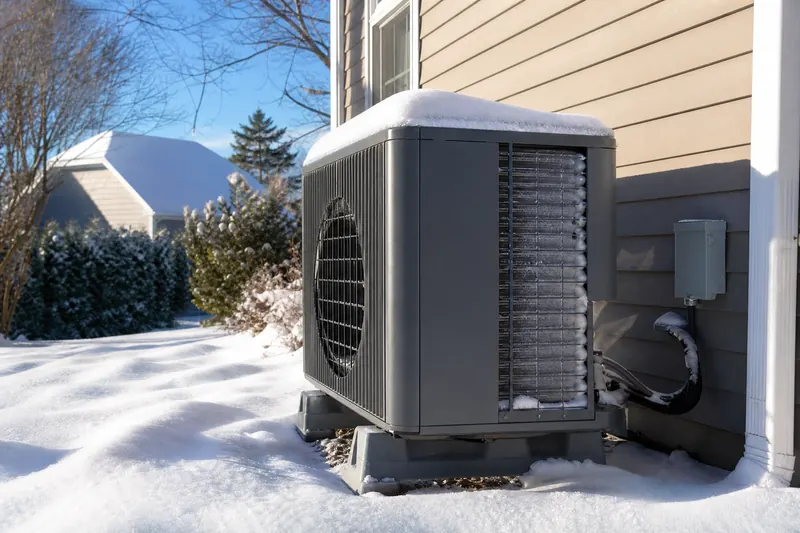
Two Front Range details matter outside. DOE recommends a unit with demand-defrost control, and an outdoor unit placed out of high winds, which can cause defrost problems, and raised if snow piles up. The National Weather Service in Boulder warns that winds of 60 to near 100 mph can occur in and near the foothills. A unit tucked on the lee side of the house, on a stand above the drift line, is a design choice worth asking for.
Part 3Which one costs less to run here?
There is no honest single answer, because it turns on the ratio between two prices and on how efficiently the heat pump runs through your particular winter. The U.S. Energy Information Administration puts the average Colorado residential natural gas price at $11.17 per thousand cubic feet in 2025, and the average Colorado residential electricity price at 16.80 cents per kWh for January through August 2026. Those are statewide averages; your Xcel bill has its own rate and its own fixed charges.
What follows from them is a pattern rather than a number. A 95% AFUE furnace, the level Xcel's rebate asks for, delivers about 95% of the fuel's energy as heat over a season. A heat pump moves more than a unit of heat for each unit of electricity, more on mild days and less on the coldest ones. Whether that beats gas depends on how many of your heating hours are mild, how well the house holds heat, and how much strip heat the system calls on. A competent bid should include an operating-cost estimate built from your own past bills, and you should ask what rate assumptions sit behind it.
Two things are plain. A heat pump that is undersized, or that hands off to resistance strips on every cold morning, can cost more to run than the furnace it replaced. And a heat pump also cools, so compare it against a furnace plus a new air conditioner, not a furnace alone. The piece on swamp coolers, central air and heat pumps covers the summer side of that comparison.
Part 4When does dual fuel make sense?
Dual fuel pairs an outdoor heat pump with a gas furnace that serves as the indoor air handler and the backup. The heat pump runs through the mild and moderate hours; when the outdoor temperature drops past a switchover point the contractor sets, the furnace takes over. It is a common way to replace a worn furnace and a worn air conditioner at the same time without betting the coldest nights on electricity alone.
It suits the typical ducted house here, such as a 1970s Littleton split-level with an aging condenser by the patio. The ducts and gas line are already there, and the heat pump takes the air conditioner's place outside.
The catch is in the incentives and the setup. Colorado's heat pump tax credit requires space-heating heat pumps to be designed to meet at least 80% of annual heating needs, so a token heat pump that hands off to gas at the first frost will not qualify. Ask the contractor to show where the switchover is set and why. And because the furnace still burns gas, the house still needs working carbon monoxide alarms; our feature on carbon monoxide and gas furnaces covers where they go.
Part 5What about houses without ducts?
Many older central Denver houses predate forced air: brick bungalows and Denver squares heated by a boiler and radiators, or by an old gravity system with big sloping ducts from a basement octopus. In those houses the furnace-or-heat-pump question often becomes boiler-or-ductless. A ductless mini-split heat pump puts small heads on the walls and needs only a line set through the wall to the outdoor unit, and it adds cooling the house never had. Our piece on ductless systems for older Denver houses goes room by room.
Keeping the boiler for the coldest nights while mini-splits carry the shoulder seasons is dual fuel in all but name, and it needs the same care about which system is called first.
Part 6What do the rebates and credits add up to in 2026?
Money is where the timing gets tight. These figures were checked on October 31, 2026; Xcel resets its program every year, so confirm the numbers with the contractor before you sign.
Xcel Energy's 2026 Colorado residential rebate summary, effective October 1, 2026, lists a ducted cold-climate heat pump at a bonus rate of $1,500, or a standard rate of $750, for each ton of heating capacity rated at 5°F. A standard ducted air-source heat pump is $600 per cooling ton bonus, $300 standard. If your main heat is already electric, such as baseboard, Xcel pays only the standard figure. A 95% AFUE gas furnace replacing a non-condensing one earns $225, but Xcel says gas furnace and boiler rebates are removed on January 1, 2027. Xcel's heat pump page says installs must be done by December 31, 2026, applications are accepted through September 30, 2027, and rebates cannot exceed the installation cost. The Xcel rebate guide walks through the contractor network.
The state's heat pump tax credit works differently from what many people remember. For installs from January 1, 2026, an air-source system carries a $1,000 credit that a registered contractor claims, passing at least $333 to you as a discount on the invoice. You file nothing. The old homeowner credit and the state sales-tax exemption ended with 2023. The regional Power Ahead Colorado rebate from DRCOG adds $1,500 per ENERGY STAR cold-climate heat pump installed by a verified contractor, and it can be combined with other incentives.
The federal credits are gone for new work. The IRS says the energy-efficient home improvement credit is not allowed for property placed in service after December 31, 2025. The $2,000 heat pump limit people still quote is history. Our tax credit piece has the dates in full.
Part 7Does Denver make you switch?
No, not for a house, going by the city pages that could be read in 2026. Energize Denver covers buildings of 5,000 square feet and up, and the city itself describes it as not a mandate to electrify heating or cooling. The electrification paperwork tied to gas-equipment permits applies to existing commercial and multifamily buildings. A furnace or air conditioner replacement in a single-family house still uses a quick permit and an inspection that checks current energy-code efficiency. The feature on Denver's rules when you replace has the detail.
Colorado follows the national minimum for split heat pumps, 14.3 SEER2 and 7.5 HSPF2. The ENERGY STAR label needs 7.8 HSPF2 and 15.2 SEER2, and the rebates ask for more than the floor, so read the model numbers on the bid.
Part 8Living with the choice: thermostats and chinook days
A heat pump wants a different habit at the thermostat. DOE's guide to programmable thermostats says they are generally not recommended for heat pumps, because a deep setback in heating mode can force the system to recover on expensive backup heat and erase the savings. Heat-pump-aware thermostats are designed to keep the strip heat to a minimum. DOE's own example is modest: at 50°F outside, nudging the setting from 66°F to 70°F should never bring the strips on.
A furnace takes setbacks in stride, and dual fuel sits in between. On a chinook day either should simply idle while the warm wind does the work. Our feature on chinook days and thermostats covers settings for both.
Part 9How to decide
Start with the house. If the ducts are sound and the furnace and air conditioner are both old, a cold-climate heat pump with the furnace kept as backup is the least risky route. If only the air conditioner is failing, a heat pump in its place can still pair with the existing furnace. If the house has a boiler and no ducts, look at ductless. And air sealing makes any of these cheaper to run.
Then ask each contractor the same questions: a room-by-room load calculation, the heat pump's capacity at 5°F from the maker's data, where the switchover or strip-heat lockout is set, where the outdoor unit goes relative to wind and snow, and which rebates and state credit they will handle on the invoice. Our guide to choosing a contractor has the rest of the list.
Common questions
Can a heat pump replace a gas furnace completely in Denver?
It can, if it is sized for the house at cold temperatures and has backup heat for the hardest hours. ENERGY STAR cold-climate units must keep at least 70% of their rated capacity at 5°F. Many households still keep a furnace or electric strips as backup for the coldest nights.
Is Xcel's gas furnace rebate still available in 2027?
No, as the 2026 summary reads. Xcel says gas furnace and boiler rebates are removed on January 1, 2027, though furnaces invoiced in 2026 can still be submitted until September 30, 2027.
Does a dual-fuel system qualify for Colorado's heat pump credit?
It can, but only if the heat pump is designed to meet at least 80% of annual heating needs and meets the other equipment rules. The contractor claims the credit and must show the discount on your invoice.
Will a chinook wind damage an outdoor heat pump?
Wind alone is mainly a defrost and placement issue: DOE advises shielding the outdoor unit from high winds. Ask the installer to place it on the sheltered side of the house and raise it above the usual snow level.
Does swapping a furnace for a heat pump need a Denver permit?
Yes. A single-family replacement goes through the city's quick permit, with no plan review, and is still inspected for current energy-code efficiency. A Denver-licensed contractor normally pulls it; see the permits feature for who else can.
Sources
- NOAA NCEI — Local Climatological Data, Denver 2023 annual summary — heating and cooling degree days, 1991–2020 normals
- Colorado Climate Center — Climate of Colorado — chinook temperature rises and winter moderation
- ENERGY STAR — Criteria for air-source and cold-climate heat pumps — cold-climate COP and capacity at 5°F, label thresholds
- U.S. DOE Energy Saver — Air-Source Heat Pumps — balance point, auxiliary heat, demand defrost, placement
- NWS Boulder — High Wind — foothill wind speeds
- U.S. EIA — Colorado natural gas prices — 2025 residential gas price
- U.S. EIA — Electric Power Monthly, Table 5.6.B — 2026 year-to-date residential electricity price
- Xcel Energy — 2026 Colorado Residential Rebate Summary — heat pump and furnace rebate amounts, furnace rebate end date
- Xcel Energy — Heat pumps — install and application deadlines, rebate cap
- Colorado Energy Office — Heat Pump Tax Credit — 2026 credit, contractor discount, 80% design rule
- DRCOG — Power Ahead Colorado heat pump rebate — regional $1,500 rebate
- IRS — FAQs on modification of sections 25C and 25D — federal credit end date