Dry Winter Air and What to Do About It
Dry winter air in a Denver house is normal, and a humidifier helps if it is kept modest. Aim for 30 to 50% indoors, turn it down before cold snaps, and use low-mineral water so the furniture does not end up dusted white.
By the editors of Heating & Cooling the Front Range · Sources checked
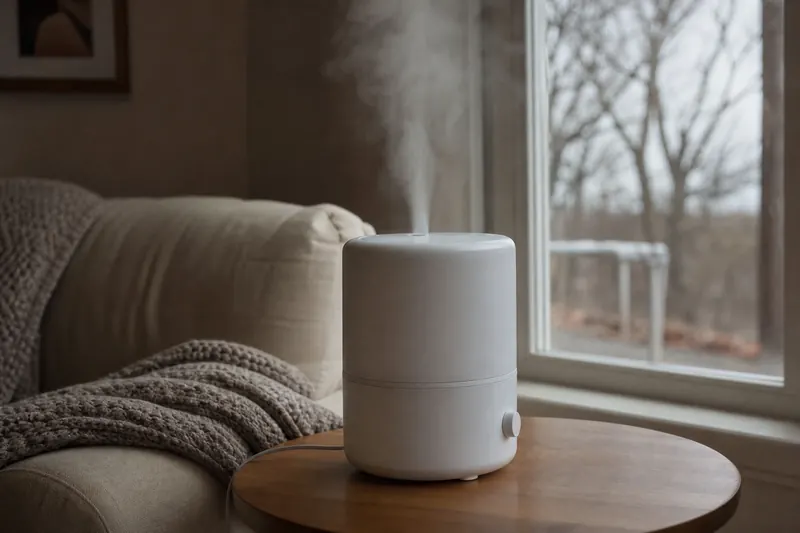
By mid-December the signs are familiar in a Front Range house. A spark jumps from the doorknob. Lips crack, the hardwood gaps open a little wider, and the furnace seems to run and run without the rooms ever feeling quite warm enough. Out the window the sky is a hard blue and the air has the thin, brittle feel of high plains winter.
None of this means anything is broken. Colorado air is dry to begin with, and winter makes it drier indoors: cold outdoor air holds little moisture, and when it leaks into the house and warms up, its relative humidity falls further. The furnace does not remove water from the air, but it heats that already-dry air for months on end.
A humidifier can take the edge off. The trick on the Front Range is that the same cold that makes the air dry also makes windows cold, so the margin between comfortable and dripping glass is narrower than people expect. The aim is a modest number, adjusted with the weather, using water that does not leave minerals all over the house.
Part 1Why is a Front Range house so dry in winter?
The climate starts it. The Colorado Climate Center puts it simply: humidity here is generally quite low, which favors rapid evaporation. That is a gift in July, when a 95°F afternoon feels tolerable and a swamp cooler can work. In January it means the air coming in through every gap around doors, windows and attic hatches carries very little water.
Chinooks add a twist. The National Weather Service in Boulder describes them as warm, dry winds coming down the eastern slopes. A chinook day can feel like spring, but it does not bring moisture with it, and the warm afternoon is often followed by a sharp cold night.
Then there is the length of the season. Denver International Airport averages 5,863 heating degree days a year on NOAA's 1991–2020 normals, so the furnace or heat pump is running for a long stretch of the year. Older, leakier houses, the brick bungalows and 1950s ranches with original windows, trade more indoor air for outdoor air and tend to feel drier than a tight newer house.
Part 2What humidity should you aim for?
The Environmental Protection Agency's guide to mold and moisture says to keep indoor humidity below 60%, ideally between 30 and 50%. Its page on home humidifiers is firmer for anyone adding moisture: do not humidify above 50%. Humidifier makers sometimes market higher targets; this magazine sticks with EPA's range.
On the Front Range, the lower half of that range is often the practical ceiling in deep winter. The glass in a window is the coldest surface in most rooms, and on a single-digit night moist indoor air condenses on it long before the hygrometer reaches 50%. A cheap digital hygrometer in the main living area, and another in a bedroom, will tell you more than how dry your skin feels.
If you heat with a heat pump, nothing changes here; humidity is about the air, not the heat source. If you are weighing that switch, the furnace or heat pump feature covers the equipment side.
EPA's indoor humidity guideposts
% relative humidity
Part 3Window condensation: the sign you have gone too far
EPA's humidifier guidance is direct about it: if water condenses on windows, walls or pictures, move the humidifier, turn its output down, or ventilate the room. Its mold guide adds that condensation can be a sign of high humidity. Wet sills grow mold, and water that runs down the glass soaks into wood frames and plaster returns.
The Front Range version of the problem comes with the weather. An arctic front can drop the overnight low by a wide margin in a day, and an indoor setting that was fine at 30°F outside is too much at 0°F. AprilAire, a maker of whole-house humidifiers, says in its owner FAQ to anticipate a drop in outdoor temperature and reduce the humidity setting to avoid condensation. Its automatic models use an outdoor temperature sensor to do that adjusting.
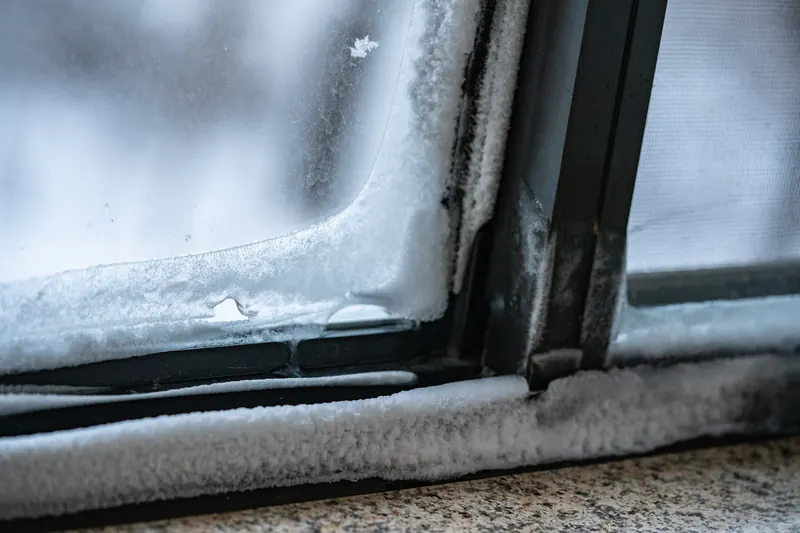
The habit worth building is to check the forecast the way you would before a ski trip. When a cold front is coming, turn the humidifier down a notch that evening, and look at the bottom corners of the coldest windows the next morning. Ice or standing water there means the setting is still too high for that weather. The chinook and thermostat feature covers the other side of those swings.
Part 4Whole-house or portable?
EPA sorts humidifiers by size and by how they put water into the air. Central humidifiers are built into the heating and cooling system and humidify the whole house. Console units stand on the floor; portable ones are smaller and serve a room. Among the room units, ultrasonic models make a cool mist with high-frequency vibration, and impeller models fling water off a fast-spinning disk.
A whole-house humidifier mounted on the furnace ductwork is the tidy answer in a ducted house: no tanks to fill, one control, and humidity spread evenly. It needs a water supply line, often a drain, and wiring to the furnace, so it is a job for a heating contractor, ideally done alongside a furnace or air handler replacement when the ducts are already open. It also needs upkeep. AprilAire says its models 300, 500, 600 and 700 need a new water panel once each humidifier season, and its 400 series every three months during the season.
A portable unit is the answer for a single bedroom, a rental, or a house heated by a boiler or ductless heads with no ducts to tie into. It is cheap to buy and easy to move, and it puts the moisture where people sleep. The cost is daily attention: filling, emptying and cleaning.
Part 5Hard water and the white dust problem
Front Range tap water carries minerals. Denver Water calls its water soft to moderately hard, says it is harder in winter, and states plainly that it tends to form scale. Its 2026 report gives a 2025 average of about 105 mg/L as calcium carbonate, roughly 6.1 grains per gallon by our conversion. Aurora Water's 2026 report gives an average of 136 mg/L, roughly 7.9 grains per gallon by the same arithmetic, with daily results ranging from 87 to 198 mg/L.
Those minerals have to go somewhere. In a whole-house unit, much of the scale collects in the water panel, which is one reason the panel needs replacing. In an ultrasonic or impeller room unit, they go into the air as fine particles and settle as a white film on dark furniture and screens. EPA says to use water with low mineral content, such as distilled water, to avoid putting minerals into the air, and to treat white dust as a sign that minerals are not being removed.
Buying distilled water by the jug works but adds up over a long Denver winter. Some households already have a reverse osmosis system under the kitchen sink for drinking water, and its output is low in minerals too. The same scale that coats a humidifier also builds up in an evaporative cooler's pads and reservoir, which the cooler start-up and shutdown feature covers.
Part 6Keeping a humidifier clean
A humidifier is a warm, wet tank, and EPA treats cleaning as part of using one. Its advice is to clean portable humidifiers every third day to reduce the buildup of scale and microorganisms, and EPA's general filter guidance applies here too: follow the maker's schedule for wicks and filters. A unit that sits half full between uses is the one most likely to grow something.
For a furnace-mounted unit, the routine is the water panel once a season or on the maker's schedule, a look at the drain line, and shutting the water supply off at the end of the heating season if the model calls for it. Ask for the humidifier to be checked during the fall furnace tune-up.
Part 7When dryness is a sign of something else
If the house still feels dry with a humidifier running at a sensible level, the problem may be air leakage rather than a lack of moisture. Gaps around attic hatches, recessed lights and old windows pull in a steady stream of dry outdoor air and push the humidified air out. By ENERGY STAR's estimate, leaks typically cost a duct system 20 to 30% of the air it carries, and a leaky return in an attic or crawlspace pulls dry air in the same way. Sealing those leaks keeps the moisture you add and cuts the heating bill.
The reverse holds in summer. A swamp cooler adds humidity as it cools, which is part of why the swamp cooler or central air decision looks so different here than in a humid state.
Common questions
Is 25% indoor humidity too low in a Denver winter?
It is below the 30 to 50% range EPA calls ideal, and many people feel the dryness at that level. Raising it a little helps, but on very cold nights watch the windows, because condensation can start at a lower reading than you might expect.
How often does a furnace humidifier's water panel need changing?
It depends on the model. AprilAire says its 300, 500, 600 and 700 models need a new panel once each humidifier season, and its 400 series every three months during the season; with Front Range hard water, check it sooner.
Can tap water go in an ultrasonic humidifier in Denver?
It can, but with water around 105 mg/L hardness the minerals end up as white dust. EPA recommends low-mineral water, such as distilled, for ultrasonic and impeller units.
Why do my windows ice up only on the coldest nights?
The glass gets colder as the outdoor temperature falls, so the same indoor humidity that was fine at 30°F condenses at 0°F. Turn the setting down before a cold front, as AprilAire advises.
Should a humidifier run during a chinook?
A chinook warms the windows and the air outdoors, so condensation risk drops for a day or two. The air stays dry, so a modest setting is fine; just turn it back down when the cold returns.
Sources
- U.S. EPA — A Brief Guide to Mold, Moisture and Your Home — 30 to 50% target, condensation as a sign of high humidity
- U.S. EPA — Use and Care of Home Humidifiers — 50% ceiling, humidifier types, distilled water, white dust, cleaning every third day
- Colorado Climate Center — Climate of Colorado — why Colorado air is usually dry
- NWS Boulder — High Wind — warm, dry chinook winds
- NOAA NCEI — Denver airport climate normals (LCD 2023) — length of the heating season in degree days
- AprilAire — Owner Center FAQ — lowering the setting before cold snaps, water panel schedule
- Denver Water — Hardness page — how the utility describes its water and its tendency to scale
- Denver Water — Annual report published 2026 — total hardness figures for 2025
- City of Aurora — Consumer confidence report — Aurora's 2025 hardness results
- ENERGY STAR — Duct Sealing — how much air leaky ducts lose