How to Choose a Front Range Contractor
Choosing an HVAC contractor in Denver starts with the city, not the search results: licensing here is local, so check the company holds the right license where you live, then compare written bids that size the system for your house.
By the editors of Heating & Cooling the Front Range · Sources checked
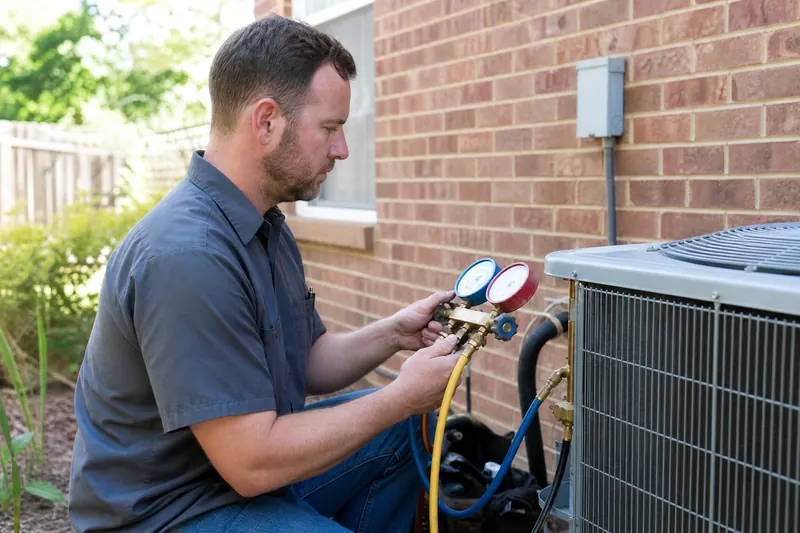
The worst time to choose a heating and cooling contractor on the Front Range is the week everyone else is choosing one. That is the first hot spell of June, when every condenser that limped through spring finally quits, or the morning after a hailstorm, when door hangers appear up and down a Littleton street. It is also the January cold snap that finds the cracked heat exchanger. Calls stack up, schedules slip, and whoever can come today starts to look like the right company.
The better approach is dull and works in any season. Licensing for this trade in Colorado is handled city by city, so begin by confirming the company is licensed or registered where your house actually stands. Ask to see the technician's refrigerant card. Find out which rebate and credit programs the company belongs to, because some of the 2026 money only reaches you through enrolled firms. Then collect two or three written bids that measure your house rather than copying the old nameplate, and read them side by side.
None of this takes inside knowledge. It takes a short list, a little patience and the nerve to ask every company the same questions.
Part 1Who licenses heating contractors here?
Mostly your city. The state's consumer protection office points homeowners to local government and says plainly that some occupations, roofers and general contractors among them, carry no state license. For mechanical work, every Front Range city we checked keeps its own rules, and no two match.
Denver works in layers. An individual earns a supervisor's certificate first; only then can the business hold a contractor license. The certificate that fits house work is the Class B heating and ventilating supervisor, limited to residential jobs. Its scope runs to air conditioners of 5 tons or smaller, warm-air furnaces, swamp coolers, gas pipe and water heaters as large as 100 MBtu, in one- and two-family houses and residential-code townhomes. To qualify, a supervisor needs six years in residential heating and ventilating, four at journeyman level. Because Denver's website refused automated reading this year, these details come from archived copies of the city's licensing pages captured in January 2025; check them against the live city office.
The suburbs each go their own way:
Aurora licenses a "Mechanical Systems Contractor," and the company needs ICC Master Mechanical Contractor certification to get it. Plumbers and electricians there work on state licenses.
Lakewood sorts contractors into registration classes. Its Class C mechanical firms can handle furnaces, air conditioning and gas lines, yet a water heater is off limits to them; that job calls for a plumbing registration.
Boulder refuses a mechanical permit to anyone lacking a current Boulder license, and a license from another city counts for nothing there.
Littleton has insisted on a license or registration before permits since 1985, and its HVAC class requires passing an ICC exam.
Englewood recognizes ICC certification and nothing else for its license exams.
We could not get Arvada's or Westminster's pages to load, so residents there should phone the building division and ask what an HVAC company needs. The broader lesson holds everywhere: a license in one city does not follow a company across the line into the next.
Part 2Refrigerant cards and the trades behind the job
Anyone who services, repairs or scraps equipment containing refrigerant must be certified under EPA Section 608. A home split air conditioner or heat pump counts as high-pressure equipment, so the matching card is Type II, or a Universal card that includes it. The cards come from approved certifying bodies; EPA says it does not hand them out. An apprentice without a card is allowed only under close, continuous supervision by a certified tech.
So ask, on the first call, who will braze, evacuate and charge the lines, and whether that person carries a 608 card. A company that does this every day answers without hesitation. Ask the same about gas pipe and wiring. A Lakewood water heater swap, for instance, belongs with a plumbing-registered firm, not just a mechanical one, and the permit should name the right trade.
Part 3Is the company enrolled where the money is?
This year, a contractor's enrollments change your price as well as your peace of mind. Three programs pay only through approved companies.
Xcel Energy routes its heat pump rebates through the Trade Partner Network, and its rebate summary tags each measure that needs a participating contractor. Colorado's heat pump credit belongs to contractors registered with the state energy office, who must show you at least $333 of the $1,000 air-source credit as a labeled discount and, since April 2026, keep up with quarterly training to stay in. Power Ahead Colorado's regional rebate, $1,500 per cold-climate heat pump, needs a contractor that program has verified.
A firm can be excellent and belong to none of them, but on a heat pump job that can cost you real money. Ask which lists the company is on, then look for those lines on the bid. Amounts and deadlines are laid out in our Xcel rebate rundown and in the state and federal credit guide.
Part 4What belongs in a written bid
Spoken quotes are hard to compare. Ask every company for the same items on paper.
How the size was chosen. The bid should say how the new equipment was sized: a heat-loss and heat-gain calculation built from the rooms, windows, insulation and ducts, not the tonnage printed on the old unit. A 1960s Aurora ranch that has gained new windows and attic insulation since its furnace went in may need less capacity than before, and a Denver square with a finished attic may need it in different places.
Model numbers and ratings. Each piece listed by model, outdoor unit, indoor coil or air handler and furnace, with SEER2 and HSPF2. The national floor applies in Colorado: a split air conditioner must reach 13.4 SEER2, and a split heat pump 7.5 HSPF2 alongside 14.3 SEER2. Xcel's air-source rebate asks for more, 7.8 HSPF2, 15.2 SEER2 and 11.7 EER2, and the state credit needs an AHRI-matched outdoor and indoor pair.
The permit. Who pulls it, and is it in the price? Denver, Aurora and Lakewood all require one for a furnace, central air, heat pump or swamp cooler replacement, like for like or not. Our guide to HVAC permits and what inspectors look for takes it from there.
Carbon monoxide alarms. When a permitted job swaps a fuel-burning appliance, Colorado law expects working alarms no more than 15 feet from each sleeping-room entrance, unless local code places them elsewhere. A careful bid says whether the house already meets that.
The money, line by line. Xcel's rebate, marked bonus or standard; the "State of Colorado Heat Pump Discount"; any Power Ahead rebate; and who files each one.
The house itself. A bungalow with no ducts, a ranch with a rooftop cooler and a two-story with a stifling upstairs each need a different conversation. A good bid shows it took place, whether it ends with ductless heads in an older house or with a closer look at why the upstairs bakes.
Part 5Red flags worth walking away from
Some warning signs are specific to this year's rules. Any one of them is a reason to get another bid.
"A straight swap doesn't need a permit." In Denver, Aurora and Lakewood it does.
"Pull the permit yourself and we'll do the work." Denver lets a homeowner pull one only for a single-family house the owner lives in, after a city exam, and the owner must then stay put for a year. Lakewood restricts homeowner permits to detached single-family homes. A company that wants your name on its permit is handing you its responsibility.
"You'll get the federal tax credit." Not for a system finished in 2026. The IRS ended 25C for anything put in service once 2025 was over.
"Claim the state credit on your return." Colorado homeowners have not claimed the heat pump credit themselves since the end of 2023; the contractor claims it and discounts your invoice.
"Denver makes you go electric." The city's electrification rules target commercial and multifamily buildings, as our look at Denver's replacement rules explains.
A bonus-rate Xcel rebate quoted for a house heated by electric baseboards. Since Nov. 16, 2025, such homes receive the standard rate.
A size chosen without measuring anything. If nobody looked at the attic, the windows or the ducts, the capacity on the bid is a guess.
Part 6After a hailstorm, slow down
Hail is part of life here; NOAA's severe storms laboratory lists Colorado among the states that usually see the most hailstorms. After a big one, outdoor units with flattened fins become a sales opportunity, and out-of-town crews sometimes follow the storm. The same checks apply: a local license or registration, a 608-certified technician, a written bid and a permit. If your condenser was hit, switch it off at the outdoor disconnect, photograph the damage and call your insurer as well as a contractor. The rest is in when hail hits the outdoor unit.
Gas smells and alarms do not wait for a quote
If you smell gas or a carbon monoxide alarm goes off while you are lining up a contractor, do not wait for anyone to arrive. Get everyone, pets included, out of the house first. Do not touch light switches, thermostats, phones or the garage door opener on the way. Once you are outside, call 911 or Xcel Energy. Gas valves, burners, venting and refrigerant are work for a licensed, certified pro.
Common questions
How can a Denver homeowner check a contractor's license?
Ask for the company's Denver contractor license number and the name of its certified supervisor, then confirm both with the city's Community Planning and Development licensing office. For house work, the certificate to look for is the Class B heating and ventilating supervisor, residential only.
Can a Denver-licensed HVAC company work in Boulder?
Only with a Boulder license as well. Boulder issues mechanical permits solely to holders of its own license and does not honor licenses from other jurisdictions.
Should the technician installing a heat pump carry an EPA card?
Yes. Whoever handles the refrigerant needs EPA Section 608 certification, Type II or Universal for home split systems. Certifying organizations issue the card, not EPA, and an uncertified apprentice may work only under close supervision.
Why does it matter whether a contractor is in Xcel's network or the state program?
Because part of the money depends on it. Xcel's heat pump rebates run through participating contractors, and Colorado's heat pump discount can come only from a contractor registered with the state energy office.
How many bids make sense for a furnace or heat pump replacement?
Two or three written bids is a practical number. What matters more is that each shows how the system was sized, lists model numbers and ratings, includes the permit and itemizes every rebate.
Sources
- Colorado Division of Professions and Occupations — Consumer protection: home and repair — some trades carry no state license; check locally
- City of Denver — Contractor Licenses, archived Jan. 13, 2025 — supervisor certificate, then company license
- City of Denver — Mechanical Certificates, archived Jan. 13, 2025 — residential Class B scope, tonnage limit, experience
- City of Aurora — Contractor licensing and lookup — state licenses for plumbers and electricians
- City of Lakewood — Contractor Registration — classes, the water heater limit, fees
- City of Boulder — Contractor licensing — local license required for a mechanical permit; no reciprocity
- City of Littleton — Contractor licensing and renewal — license required since 1985; ICC exam
- City of Englewood — License examinations — ICC certification only
- EPA — Section 608 certification requirements — Type II; apprentices
- State of Colorado energy office — HPTC contractor program — registration, discount, training
- Xcel Energy — Heat pumps for Colorado homes — trade partner contractors
- NOAA National Severe Storms Laboratory — Hail basics — Colorado among the most hail-prone states