Opening and Closing an Evaporative Cooler
Evaporative cooler start up begins with the power off and locked out, then clean pads, a working bleed and water on before power. Fall shutdown runs in reverse: water off, everything drained, the cabinet covered. Steep or slick roofs go to a pro.
By the editors of Heating & Cooling the Front Range · Sources checked
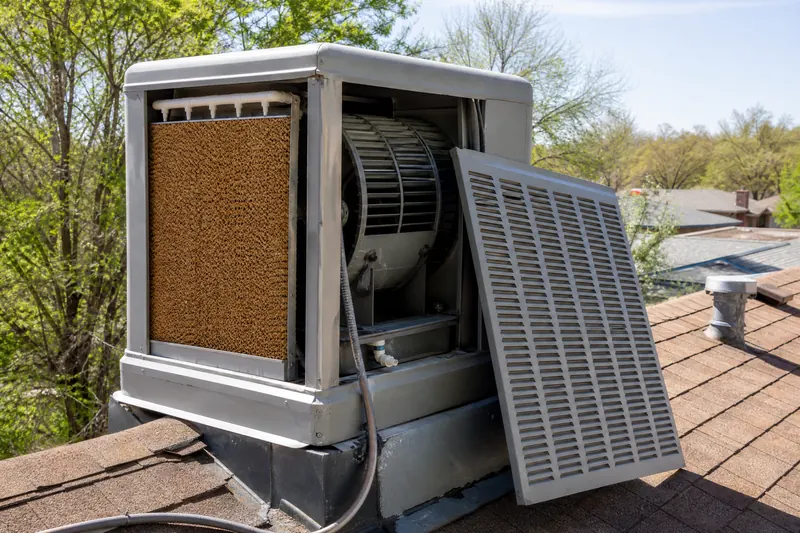
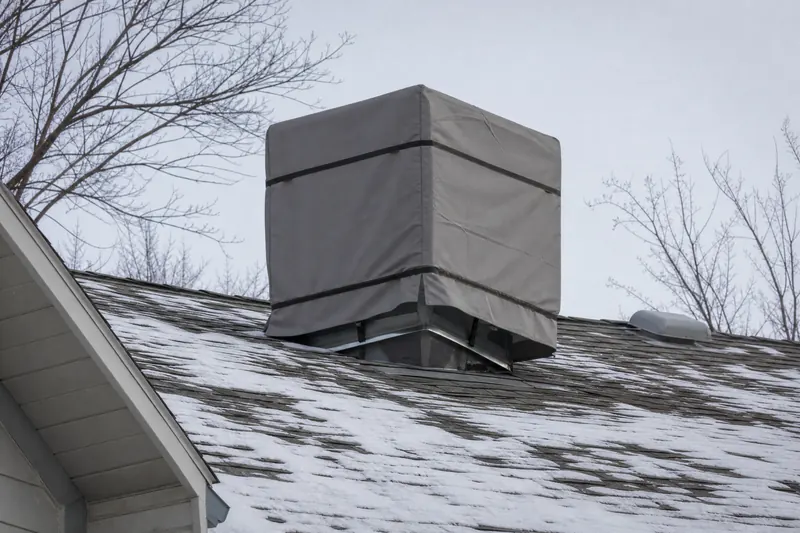
Somewhere around the first properly warm week of late spring, a lot of Front Range ranch houses get the same Saturday chore. The cooler on the roof has spent the winter under a strapped canvas bag, its water line dry and its pads stiff with last summer's scale. Before it can cool anything, it has to be woken up in the right order.
Done well, opening a cooler is an hour or two of unglamorous work: power off, cover off, pads out, a hard look at the pan and the pump, water on, then power on. Closing it in fall is the same list backward, with one extra rule that matters more here than almost anywhere: every drop of water has to come out before the first hard freeze.
What follows is built from what makers actually tell owners to do, chiefly the Breezair owner's manual from Seeley International and MasterCool's operating instructions, plus the Department of Energy's maintenance advice. Where a manual says to leave a job to a dealer or service agent, we say so too.
Part 1First, the power and the ladder
Every manual we could verify starts in the same place. DOE's Energy Saver page on evaporative coolers tells owners to disconnect the electricity before servicing a unit. The Breezair manual goes further: switch power off at the service panel and lock the disconnecting means, or tag it if it cannot be locked. MasterCool's instructions say to disconnect power, turn the unit off and shut the water supply before any maintenance. Nobody should reach into a cooler that could start on its own.
Then think hard about getting up there. Seeley's manual suggests leaving roof-mounted maintenance and checks to an authorised dealer or service agent, and it warns that climbing onto the roof can be hazardous and could result in injury. DOE notes that routine maintenance on roof units can wear the roof itself. If you do the work, do it on a dry, calm day with someone holding the ladder.
Roof coolers and power
Switch the cooler off, then kill the power at the disconnect or the panel and lock or tag it before you touch anything inside the cabinet. Never work on a unit that is running. Have someone hold the ladder, and stay off the roof when it is wet, icy or windy. If the pitch is steep, the shingles are fragile or you are unsure at any point, hire it out. Wiring, motor and pump electrical repairs are for a licensed pro.
Part 2Spring start-up, in the maker's order
The Breezair pre-season list is a good template, and its order matters. With the power still off, inspect the cabinet and the duct where it drops through the roof for rust, gaps and anything that nested over winter. Lift out the pad frames and wash them gently; the manual specifically warns against high-pressure spray, which tears the media. Refit the bleed system, check that the fan turns freely, refit the pads, close the cabinet, and only then turn the water on, followed by the power.
With water flowing, watch the distributor, the drain hose and the float valve from outside the cabinet, without reaching in. The float should shut the supply off at the right level rather than letting it run to the overflow. If anything needs adjusting, switch the power off and lock it out again before you open a panel. Check through the louvers that the pads wet evenly from top to bottom; dry streaks let warm air straight through and leave a cooler blowing lukewarm air at full volume.
Inside the house, open the relief before you switch to cool. DOE says to give 1 to 2 square feet of window or vent opening, on the downwind side, per 1,000 cfm the cooler is rated for. Too little and the house turns muggy; too much and the cool air is diluted by hot air coming the other way.
Part 3Bleed, purge and Front Range water
Water leaves a cooler two ways: as vapor through the pads, and as a small stream deliberately thrown away. The second part is what keeps the first working. The Breezair manual explains that the bleed drains small amounts of water so fresh supply keeps diluting the salts that concentrate as water evaporates; the installer sets the rate. MasterCool describes the same job done either by a steady gravity bleed or by a timed purge pump, and says the water must leave the unit so mineral and bacteria build-up do not occur.
How much bleed is enough depends on what comes out of your tap. Denver Water calls its supply soft to moderately hard and says it tends to form scale; its 2026 water quality report gives a 2025 average total hardness of about 105 mg/L, with readings from 55 to 124 mg/L. Aurora's 2026 report put its average at 136 mg/L, ranging from 87 to 198 mg/L. Grain figures are our own conversions. MasterCool's annual maintenance heading adds that the work may be needed more often where water is hard.
If the pan grows a white crust within weeks, or the pads go stiff and chalky long before midsummer, the bleed may be set too low for your water or blocked. Breezair's manual makes the bleed setting the installer's call, so a service visit is the safe first step.
Part 4Through the summer: pads and a monthly look
DOE says that where a cooler runs often, someone should look at the pads, filters, reservoir and pump at least once a month. Pads should be replaced at least twice during the cooling season, and as often as monthly when the unit runs around the clock. Each of those checks starts the same way as spring: unit off, power off at the disconnect.
DOE also recommends a cooler with at least two speeds and a vent-only mode. Vent-only runs the fan without the pump, turning the cooler into something like a whole-house fan for mild evenings, and gives the pads a chance to dry out between hot spells.
Part 5What about smoky and ozone days?
A cooler's strength is fresh outdoor air, and that is exactly the problem when the air outside is bad. When wildfire smoke settles over the city, turn the cooler off or use it sparingly. EPA's wildfire guidance for indoor air says the alternative is to completely cover the outside air intakes with 4-inch MERV 13 furnace filters, and only if the cooler can be reached safely. It adds that those outside filters may need frequent replacement because of wind or rain. On a roof, that is a lot of ladder trips, which is why most owners just shut the unit down. Our guide to smoke and furnace filters covers what to do indoors instead.
Ozone needs a different answer, because it is a gas and the pads do nothing to it. EPA notes that ozone can reach unhealthy levels on hot, sunny days. On an Ozone Action Day, lean on the cooler in the cool of the morning and evening and back off through the hot middle of the day, particularly if anyone at home has asthma. Our piece on ozone days explains the timing.
Part 6Fall shutdown, before the first hard freeze
The goal in fall is a cooler with no water left in it anywhere. MasterCool's winterizing steps run like this: turn off the water supply, turn off and unplug the cooler, soak up any remaining water and drain the pumps, then disconnect and drain the hoses and the water distributor. The manual says plainly that pulling the overflow fitting is not adequate draining for winter. Where temperatures drop well below freezing, it suggests taking the supply line off the outside faucet altogether.
Breezair's end-of-season list covers the same ground for a roof unit: power off, water off, pad frames out, the isolating switch inside the cooler off, water channels cleaned, the bleed funnel removed so the tank drains, the tank and pump filter cleaned, then the pad frames back in. Where the supply pipe could freeze, the installer should have fitted a drain-down facility, and Breezair says it must be activated before freezing weather arrives.
Last comes the cover. MasterCool says to wrap the outside of the unit in a heavy bag and secure it with straps. On the Front Range, where winter wind off the foothills can be ferocious, those straps earn their keep. A cover that blows off in January leaves cold air pouring down the duct into the hallway until spring.
Part 7When to call someone instead
Some of this is squarely a contractor's job. Anything involving wiring, the motor or a pump that hums but will not run belongs to a licensed pro, as does a leaking roof penetration. So does a replacement: Denver treats a new evaporative cooler in a single-family or duplex house as quick-permit work that is still inspected, going by the city pages we were able to read in 2026, and Aurora's homeowner handbook says a swamp cooler always needs a permit. Our permits guide covers who pulls them.
If a new cooler is on the table, Xcel's 2026 summary rewards the better-built ones: a premium cooler with a purge pump and thermostat earns $675, a basic model of at least 2,500 cfm gets $300, and a premium multi-duct setup reaches $1,200. We checked those figures on October 31, 2026. Xcel revises its rebates every year, so confirm the numbers before you sign. Whether to keep a cooler at all, or move to central air or a heat pump, is the subject of our swamp cooler or central air comparison, and our contractor guide covers getting a fair bid.
Common questions
Why does my evaporative cooler smell musty after spring start-up?
Stale water and old pads are the usual cause. Drain and clean the pan, replace the pads and check that the bleed or purge is actually removing water, since MasterCool notes that water must leave the unit to keep mineral and bacteria build-up away. If the smell persists after fresh pads, have the unit serviced.
Is it safe to start a swamp cooler before the last spring freeze?
Not if water can sit in lines that freeze overnight. Breezair's manual ties its drain-down facility to freezing conditions, and MasterCool warns about supply lines in hard cold. Wait until nights stay above freezing, or be ready to drain again.
Do cooler pads need replacing every spring?
DOE says to replace them at least twice during the cooling season, so a fresh set at start-up is a sensible habit. Hard Front Range water scales pads faster, and stiff, crusted media passes warm air without cooling it.
Can the water stay connected over a Denver winter if the cooler is covered?
No. MasterCool's winterizing steps include shutting off and disconnecting the water, draining the pumps, hoses and distributor, and in hard-freeze areas taking the supply line off the outside faucet. A cover keeps out wind and snow; it does not stop pipes freezing.
Who should set the bleed rate on a cooler?
The installer, according to Breezair's manual. If you see heavy scale early in the season, have the setting checked against your water's hardness rather than guessing.
Sources
- DOE Energy Saver — Evaporative Coolers — disconnecting power first, monthly checks, pad replacement, window opening, vent-only mode, roof wear
- EPA — Wildfires and Indoor Air Quality — what to do with a cooler on smoky days, intake filters and their upkeep
- Denver Water — Water hardness — soft to moderately hard, scale-forming supply
- Denver Water — 2026 water quality report — Denver's 2025 average and the spread of readings
- Aurora Water — 2026 water quality report — Aurora's average hardness and its daily range
- Xcel Energy Colorado — Residential heating and cooling rebates — 2026 evaporative cooler rebates and deadlines
- Denver Community Planning and Development — Quick permits — quick permits for replacement evaporative coolers
- EPA — Health Effects of Ozone Pollution — ozone on hot, sunny days and who is most at risk