When Hail Hits the Outdoor Unit
Hail damage to an AC condenser usually shows as flattened fins and dented panels. Switch a battered unit off at the disconnect, photograph everything, and let a contractor and your insurer judge it before anyone straightens, repairs or replaces a thing.
By the editors of Heating & Cooling the Front Range · Sources checked
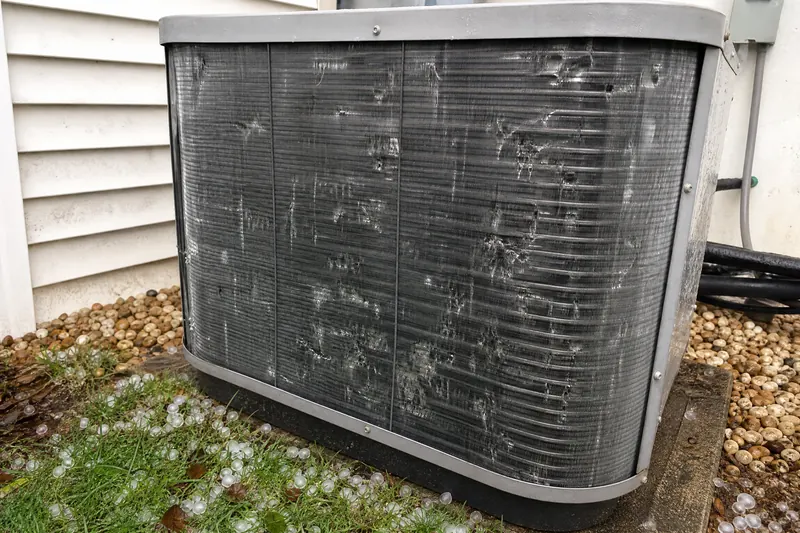
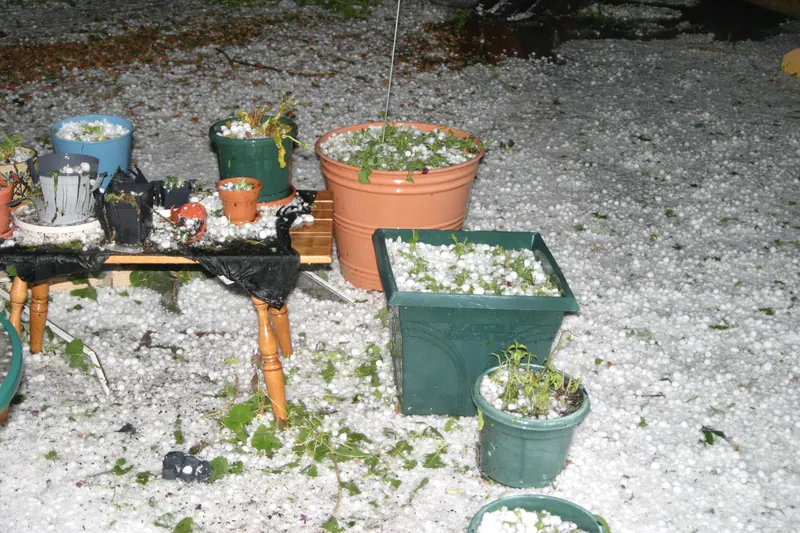
It tends to start the same way. A bruise-colored shelf of cloud builds over the foothills in the early afternoon, the wind turns cold and gusty, a few heavy drops smack the driveway, and then the ice arrives, rattling off the gutters and stripping the leaves from the ash tree. When the cell moves east toward the plains, the back patio is white, the hostas are shredded, and the grey metal box beside the house, the one that was humming along an hour ago, sits in a little drift of hailstones.
That box is the outdoor half of a central air conditioner or heat pump, and it lives where the hail falls. Its job is to throw the heat pulled out of the house into the outdoor air, and it does that through a coil wrapped in thin aluminum fins. Those fins are what a hailstorm finds first.
The short answer for the hour after a storm: look from the ground, do not touch or poke at a running unit, switch it off at the outdoor disconnect or the breaker if it is visibly beaten up, take photographs, and call a heating and cooling contractor and your insurer. Combing, coil repair and refrigerant work all come later, and none of it is a homeowner job.
Part 1Why does the Front Range get so much hail?
Geography does most of the work. The National Severe Storms Laboratory says Nebraska, Colorado and Wyoming usually have the most hailstorms in the country, and that the area where the three states meet, sometimes called hail alley, averages seven to nine hail days a year. The Denver metro area sits southwest of that meeting point.
The Colorado Climate Center puts it more locally. Thunderstorms are common on the eastern plains and along the eastern slopes of the mountains in spring and summer, they often turn severe, and some eastern Colorado counties average six or more hail days a year, which ranks them among the most hail-prone places in the United States. In practice that means the outdoor unit on a Littleton ranch or an Arvada two-story will probably meet hail more than once in its working life.
Part 2What hail actually does to a condenser
Walk around a typical outdoor unit and you will see a square or round metal cabinet, a fan grille on top, and on three or four sides a coil of copper or aluminum tubing threaded through rows of very thin aluminum fins. Behind louvered panels sit the compressor and the electrical parts. Hail falling straight down mostly hits the top grille and the cabinet lid. Hail driven sideways by storm winds hits the fin faces, and NSSL notes that wind-driven hail is strong enough to tear up siding and break windows, so thin aluminum fins do not stand much chance.
What you usually find afterward is a patchwork of flattened fins, sometimes over a whole face of the coil, plus dimples in the cabinet. Dents in the sheet metal are often cosmetic. Crushed fins are not, and the worry with heavy hail is that a stone has gone through the fins and nicked the refrigerant tubing behind them. Only a technician with gauges can tell you whether the circuit is still tight.
Part 3Why flattened fins are not just cosmetic
The Department of Energy explains the problem plainly: the aluminum fins on condenser coils "are easily bent and can block airflow through the coil," according to its air conditioner maintenance guide. The outdoor fan pulls air through those fins to carry heat away. Close the gaps and less air moves, so the refrigerant leaves the coil hotter than it should and the system has to run longer to do the same work.
That matters most on exactly the days you need it. Denver's normal July high at the airport is about 90°F, and the 1991–2020 normal is about 46 days a year at 90°F or above, according to NOAA's climate summary for Denver International Airport. DOE also warns that skipping needed maintenance brings a steady decline in performance while energy use climbs. A coil that is half flattened in June is a coil that struggles all of July.
Part 4The first hour after the storm
Wait until the storm has fully passed and there is no lightning. Then look from a few steps back, without touching anything. Is the fan turning smoothly, or scraping and rattling? Are fins crushed across a large patch, or just speckled? Is anything hanging loose, or is there oily residue on the coil that was not there before? Do you hear hissing?
If the unit looks or sounds wrong, switch it off at the outdoor disconnect box mounted on the wall beside it, or at the breaker in the panel, and leave it off. Then document. Take wide shots that show the unit, the house and the hail on the ground, close shots of every damaged face, and a clear picture of the data plate with the model and serial numbers. Photograph the roof, gutters, siding, window screens and any swamp cooler on the roof too, because the adjuster will be looking at the whole property. Hailstones melt fast in Front Range sun, so do this early.
Leave the fins and the cabinet alone
Do not comb or straighten fins, pressure-wash the coil, pull off panels, or poke at a unit that is running. If it is damaged, switch it off at the outdoor disconnect or the breaker and keep it off until a contractor has looked. Refrigerant work is legally limited to EPA Section 608 certified technicians, and anything inside the electrical compartment belongs to a licensed pro. If you are unsure whether it is safe to run, leave it off and call one.
Part 5Comb, repair or replace?
For light damage, the fix can be simple. DOE notes that heating and cooling wholesalers sell a fin comb that brings bent fins back to nearly their original condition, and a technician can work through a speckled coil in a service visit. Combing a coil that has been flattened across whole faces is slower and less complete, and at some point the honest answer is a new coil or a new outdoor unit.
If a stone has punctured the tubing, the system has lost refrigerant, and the repair is refrigerant work. The EPA's Section 608 rules require anyone who services refrigerant-containing equipment to be certified, and home split air conditioners and heat pumps fall under the Type II category for high-pressure appliances. Ask to see the technician's card, and know that EPA does not issue those cards itself; the certifying organizations do.
If the unit is old, a contractor may recommend replacement rather than coil work. A new split central air conditioner must meet the national minimum of 13.4 SEER2, and a split heat pump 14.3 SEER2 and 7.5 HSPF2, under 10 CFR 430.32. Colorado sits in neither of the federal regions with higher floors, so the national number is the one that applies here.
Efficiency floors for a replacement outdoor unit
SEER2
Part 6Is a hail-killed air conditioner the moment to switch?
Sometimes it is. If the outdoor unit has to go anyway, a heat pump in the same spot can cool in summer and carry much of the winter heating, which is the trade-off weighed in our piece on furnace or heat pump on the Front Range. The money has shifted toward heat pumps, too. Xcel Energy's 2026 rebate summary, effective October 1, 2026, has no row at all for a stand-alone central air conditioner. A ducted air-source heat pump that meets 15.2 SEER2, 11.7 EER2 and 7.8 HSPF2 earns $300 per cooling ton at the standard rate or $600 at the bonus rate, and a ducted cold-climate model earns $750 or $1,500 per heating ton at 5°F, according to the Xcel residential rebate summary. If the house already runs mainly on electric heat, Xcel pays only the standard figure. Installs must be finished by December 31, 2026, with applications by September 30, 2027. We read those figures on October 31, 2026, and Xcel rewrites them every year, so check the current program details before signing anything.
The state's heat pump tax credit is claimed by the registered contractor, not by you; for an air-source system installed in 2026 it is $1,000, and at least $333 must show on your invoice as the "State of Colorado Heat Pump Discount." The federal credits are gone for anything placed in service after December 31, 2025, as covered in our look at what is left in heat pump tax credits. How an insurance settlement and an upgrade fit together is a question for your insurer and your policy, not something we can answer for every case.
Part 7Can a hail guard protect the unit?
Guards and louvered panels are sold for outdoor units, and some owners fit them in hail-prone neighborhoods. What we could not find was any primary source showing that a guard prevents hail damage or keeps a coil working at full efficiency, so treat claims to that effect with caution. The one thing that is certain is that anything around the unit must not choke the airflow. DOE's only number here is to keep foliage trimmed back at least 2 feet from the outdoor coil; for a guard, follow the clearances in your unit's own installation manual, and ask the installer whether the manufacturer's warranty says anything about add-on panels. Never run the unit with a solid cover or tarp over it.
Part 8Getting the inspection and the claim right
After a big storm, door-to-door crews follow the hail. A Denver heating and cooling contractor needs a city supervisor certificate and then a contractor license, Aurora licenses mechanical contractors who hold ICC Master Mechanical certification, and Lakewood and Boulder run their own registration and licensing, so ask which city license the company holds and check it. Our guide to choosing a contractor goes through the rest.
A useful inspection report names the damage face by face, says whether the refrigerant circuit is intact, and gives a written recommendation with model numbers. Keep it with your photographs. If the answer is replacement, Denver treats a single-family air conditioner swap as a quick permit that is still inspected and must meet current efficiency, going by the Denver pages that could still be read this year; Aurora and Lakewood require permits as well. The permits and inspections piece explains who pulls them. Policies differ on deductibles, timelines and what counts as cosmetic, and we could not confirm current Colorado Division of Insurance hail guidance, so read your own policy and ask the insurer directly.
Common questions
Do a few bent fins after a small hailstorm need a service call?
A light speckling of bent fins on one face is common and may cost little in performance. If the unit runs quietly and cools as before, it can wait for the next routine visit, when a technician can comb the worst spots. Widespread flattening, noise or a loss of cooling is a reason to switch it off and call sooner.
Should the outdoor unit be covered when hail is forecast?
We found no primary source that tests storm covers on condensers, so we can't say they work. If you choose to cover the unit, switch the system off first and take the cover off completely before it runs again, because a covered coil cannot breathe.
Can hail damage to the outdoor unit show up weeks later?
It can. A small nick in a refrigerant tube may leak slowly, so cooling fades over days or weeks instead of failing at once. That is one reason to have a technician check the circuit after a hard storm rather than relying on how the unit sounds that evening.
Does a dented cabinet mean the unit has to be replaced?
Not by itself. Dents in the lid or side panels are often cosmetic, and the unit can run normally with them. Replacement usually comes down to the condition of the coil, the refrigerant circuit and the age of the system, which a technician judges on site.
Sources
- NOAA National Severe Storms Laboratory — Severe Weather 101: Hail — hail alley, seven to nine hail days, wind-driven hail damage to houses
- Colorado Climate Center — Climate of Colorado — spring and summer severe storms, six or more hail days in some eastern counties
- DOE Energy Saver — Maintaining Your Air Conditioner, archived copy — bent fins block airflow, fin combs, 2-foot foliage clearance, maintenance and efficiency
- NOAA NCEI — Local Climatological Data, Denver International Airport — July normal high and days at 90°F or above
- eCFR via GovInfo — 10 CFR 430.32 energy conservation standards — national SEER2 and HSPF2 minimums
- ENERGY STAR — Air-Source Heat Pump key product criteria — 15.2 SEER2 for split heat pumps
- EPA — Section 608 Technician Certification — certified technicians only for refrigerant work; cards issued by certifying organizations
- Xcel Energy — Colorado residential rebate summary, effective Oct. 1, 2026 — heat pump rebates per ton, no central AC row
- Colorado Energy Office — Heat Pump Tax Credit — contractor-claimed credit and minimum discount
- IRS — FAQs on the 25C and 25D changes — federal credits end after Dec. 31, 2025
- City and County of Denver — Quick Permits, archived copy — single-family AC replacements, efficiency checked at inspection