Ductless Heat Pumps in Houses Without Ducts
A ductless mini-split suits Denver's older brick houses because it needs no ductwork: a small refrigerant line through the wall links an outdoor unit to wall heads that cool in summer and, with a cold-climate model, carry much of the winter heating.
By the editors of Heating & Cooling the Front Range · Sources checked
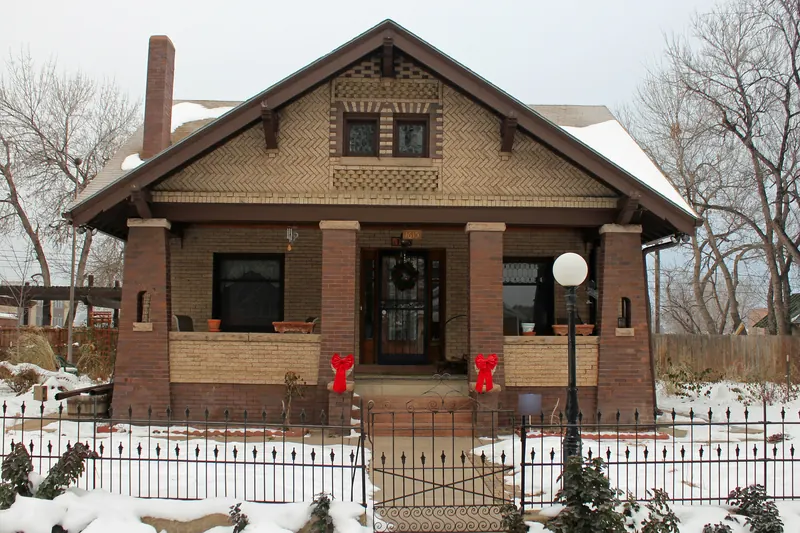
Picture a 1920s brick bungalow in Washington Park or a Denver square in Capitol Hill. Thick plaster walls, oak trim nobody wants to cut, cast-iron radiators under the windows fed by a boiler in the basement. It is a lovely house to be in during January. In July it is another story: window units rattling in the bedrooms, a fan on every dresser, and the upstairs holding the day's heat well into the night.
Houses like this were built for a different century. Some never had ducts at all. Others had gravity warm-air systems with big, low-slung ducts that were never sized for air conditioning. Running new ductwork through finished plaster is disruptive and expensive, and often there is simply nowhere to put it. That is the problem ductless mini-splits were made for.
The short version: a ductless system pairs an outdoor heat pump with one or more indoor heads mounted high on a wall or ceiling, joined by a small bundle of refrigerant tubing, power and a drain line through a hole in the wall. It cools room by room in summer. A model rated for cold climates can also heat in a Front Range winter, either on its own or alongside the boiler. It has trade-offs, mostly around filtration, appearance and where the heads can go, and it is not a do-it-yourself job.
Part 1How does a ductless system work in a house with no ducts?
The outdoor unit looks like a slim air conditioner condenser. Inside the house, each head contains a coil and a quiet fan that pulls room air across it and blows it back out, cooled in summer or warmed in winter. Because the air is treated right in the room, nothing has to travel through ducts. The Department of Energy points out that duct losses can account for more than 30 percent of the energy used for space conditioning, especially when ducts run through an attic, and a ductless system avoids those losses entirely, according to its ductless mini-split page.
The connection between the units is modest. DOE says it generally needs only a three-inch hole through the wall for the conduit, and that the outdoor unit can sit as far as 50 feet from the indoor unit. For a brick house that means one tidy penetration per head rather than a chase cut through two floors. Many systems can run as many as four indoor units from a single outdoor unit, and each zone gets its own thermostat, so a bedroom can be cool at night while an empty front room is left alone.
Part 2Where the heads go in a bungalow or a Denver square
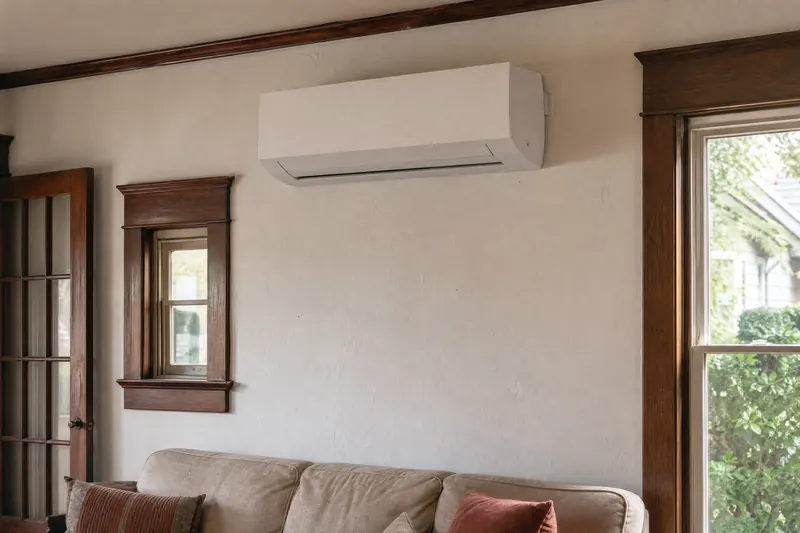
Placement is where a good installer earns the fee. Heads work best high on an exterior wall, where the line set can go straight out, with clear air in front of them and no furniture or curtains blocking the throw. In a bungalow that often means one head in the main living space and one in each bedroom, or one head covering two small rooms if doors stay open. In a Denver square, the second floor is usually the priority, because heat rises and the upstairs bedrooms are the hardest to cool.
Each head also needs a condensate drain, which runs outside or to a pump, and power from the outdoor unit. In houses with plaster and lath, the installer has to plan routes for the line set that avoid cutting into finished walls, often running it down the outside of the house in a cover painted to match the brick. Ceiling cassettes and slim ducted units in an attic or closet are options where a wall head would look wrong, though the slim-ducted kind brings back a little ductwork.
Part 3Will it heat a brick house through a Front Range winter?
That depends on the model. Denver averages about 5,863 heating degree days a year against 849 cooling degree days, per the NOAA 1991–2020 normals for Denver International Airport, so heating is the bigger job by far. To earn ENERGY STAR's cold-climate label, a heat pump's efficiency at 5°F, measured as a coefficient of performance, cannot fall below 1.75, and its output at 5°F has to be no less than 70 percent of what it makes at 47°F, according to the ENERGY STAR heat pump criteria. Non-ducted cold-climate systems also need at least 8.5 HSPF2 and 15.2 SEER2. ENERGY STAR requires third-party testing of low-temperature performance down to 5°F.
Chinook days and sunny afternoons help, because a heat pump is most efficient when it is mild outside. On the coldest nights, a house still needs enough capacity to cover the load, and DOE notes that below the balance point, a heat pump relies on auxiliary heat to keep up. In a house with a working boiler, that backup is already in the basement. Many owners keep the radiators for the deepest cold and let the mini-split do the cooling and the shoulder-season heating. The furnace-versus-heat-pump trade-offs for ducted houses are in our look at the furnace-versus-heat-pump question.
Two placement points from DOE's air-source heat pump guidance matter here: keep the outdoor unit out of strong wind, which DOE links to defrost trouble, and lift it above where snow collects. Along the foothills, where chinook gusts can be ferocious, a sheltered side of the house and a stand or wall bracket are worth asking about.
Leave the line set and wiring to the installer
Connecting a mini-split means handling refrigerant, which federal rules limit to EPA Section 608 certified technicians, plus high-voltage wiring and a new circuit at the panel. Do not open the line set, the service valves or the electrical cover on either unit. If a head stops working, check the breaker and the remote's batteries, then call a licensed pro.
Part 4What are the trade-offs?
Filtration is the big one. DOE notes that ductless systems avoid duct losses but lack high-efficiency MERV filtration and the ability to add ventilation. The heads have washable mesh screens that catch dust and lint, nothing like a MERV 13 furnace filter. In a house without ducts, that means wildfire smoke days call for portable air cleaners in the rooms where people spend time, as our piece on wildfire smoke and filters explains.
Appearance is the next. A white plastic head on a plaster wall in a 1920s living room is not invisible, and some owners never warm to it. Floor consoles, ceiling cassettes and careful color choices on the outdoor line-set cover help. Then there is upkeep: the screens need regular rinsing, and the coils and blower wheels inside the heads need professional cleaning from time to time, especially in dusty, dry summers. Finally, more heads mean more cost, and a system with a head in every small room can end up oversized for each one, which hurts comfort. A good contractor sizes each room rather than each wall.
Part 5What Xcel, the state and the region pay in 2026
Xcel Energy's 2026 summary, effective October 1, treats a non-ducted mini-split that heats at least half the home very differently from one used for a single room, according to the Xcel residential rebate summary. For the whole-home case, an air-source unit earns $300 a cooling ton (standard) or $600 (bonus), and a cold-climate unit earns $750 or $1,500 a heating ton. A mini-split used as a supplement, for a garage, addition or one room, gets a flat $500, standard rate only. The bonus rates are not paid where existing electric heat, such as baseboard, is the main heat source. Installs must be complete by December 31, 2026, and applications are taken through September 30, 2027. We read these terms on October 31, 2026; Xcel resets them each year, so see our Xcel rebates feature and confirm before signing.
Xcel 2026 rebates for non-ducted mini-splits
dollars
Colorado's heat pump credit goes to the registered contractor, who must pass at least a third of it along as a visible line-item discount; for an air-source install in 2026 the credit is $1,000 and the minimum discount $333. The equipment must be ENERGY STAR certified and AHRI-matched, and a space-heating heat pump must be designed to meet at least 80 percent of the home's annual heating needs, so a single head for one bedroom may not qualify. Regionally, the Denver Regional Council of Governments' Power Ahead Colorado pays $1,500 toward each ENERGY STAR cold-climate unit installed by one of its verified contractors, and it stacks with other offers. Federal credits do not cover equipment placed in service from 2026 on; our piece on heat pump tax credits has the detail.
Part 6Permits, licensing and who does the work
Xcel's heat pump page says a mini-split can qualify for a rebate when the homeowner installs it, but the refrigerant connections are Section 608 work and the electrical tie-in needs a permit, so our advice is to treat it as a professional job. Denver's quick-permit list for single-family houses includes residential A/C compressor units, the work is still inspected, and replacement equipment must meet current energy-code efficiency, going by the city pages readable in 2026; your contractor will know which permit a new system needs. The city's residential heating and ventilating supervisor certificate covers air conditioning of 5 tons or less. Denver has no rule we could find that makes a single-family homeowner switch to a heat pump; the city's electrification requirements apply to commercial and multifamily buildings, as our Denver rules piece explains. Aurora, Lakewood, Boulder, Littleton and Englewood license or register mechanical contractors separately, and our guide to choosing a contractor covers what to check.
Common questions
Can a ductless system replace a boiler completely in an old Denver house?
It can if the heads are sized for the full winter load and the model holds its capacity in deep cold, which is what the cold-climate rating is about. Many owners keep the boiler as backup instead, at least for the first winter, to see how the mini-split copes. A room-by-room heat-loss calculation tells you which route fits the house.
How many indoor heads does a typical bungalow need?
There is no fixed number. Open floor plans can share heads, while closed bedrooms usually need their own. DOE notes that many outdoor units can run up to four indoor units, and a contractor should size each one to its room rather than fitting the biggest model everywhere.
Is a ductless head noisy enough to bother a bedroom?
Indoor heads are generally quiet, with the compressor outdoors. Fan noise rises on the highest speed, so a head that is sized correctly and runs on low most of the time is quieter than one that has to race. Ask to hear a working unit if you can.
Do mini-splits work with gravity-duct houses that once had a coal furnace?
Ductless heads ignore the old ducts entirely, so yes. Some owners use slim ducted mini-split air handlers to reuse a short run of existing duct, but the big gravity ducts of an old warm-air system usually are not suitable as they stand. A contractor can inspect them.
Will a mini-split clean the air during smoke season?
Not much. The heads have mesh screens, not MERV-rated filters, and DOE notes ductless systems cannot add high-efficiency filtration or ventilation. Plan on portable air cleaners for smoky days.
Sources
- Department of Energy mini-split guide, Internet Archive copy — four indoor units, three-inch hole, 50 feet, duct losses over 30 percent
- Department of Energy air-source heat pump guide, Internet Archive copy — wind and snow placement, balance point, no MERV filtration in ductless systems
- ENERGY STAR — heat pump key product criteria — the cold-climate efficiency and output tests, non-ducted HSPF2 and SEER2
- ENERGY STAR — Air-Source Heat Pumps — low-temperature testing to 5°F
- NOAA NCEI — Denver airport climate normals, 1991–2020 — heating and cooling degree days
- Xcel Energy — 2026 residential rebate summary for Colorado — non-ducted and supplemental mini-split rebates
- Xcel Energy — Heat Pumps, Colorado residential — dates, installer rules, mini-split self-install note
- State heat pump credit page, Colorado Energy Office — this year's amounts, contractor claim, 80 percent design rule
- DRCOG — Power Ahead Colorado heat pump rebate — $1,500 per cold-climate heat pump
- EPA — Section 608 certification requirements — Type II for residential split systems
- City and County of Denver — Mechanical certificates, archived copy — residential certificate covers A/C of 5 tons or less