Swamp Cooler, Central Air or a Heat Pump?
A swamp cooler suits Denver's dry summers and uses about a quarter of central air's energy, but it needs open windows, water and roof upkeep, and it pulls in smoke and ozone. Central air or a heat pump keeps the house shut.
By the editors of Heating & Cooling the Front Range · Sources checked
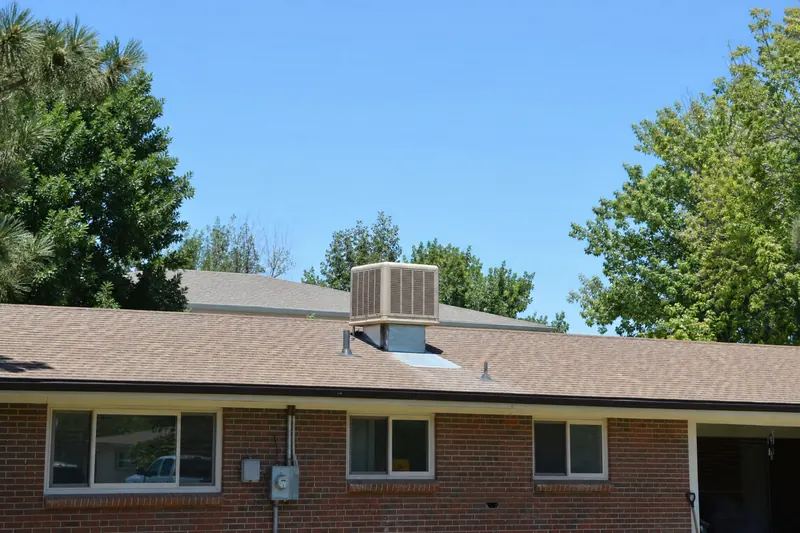
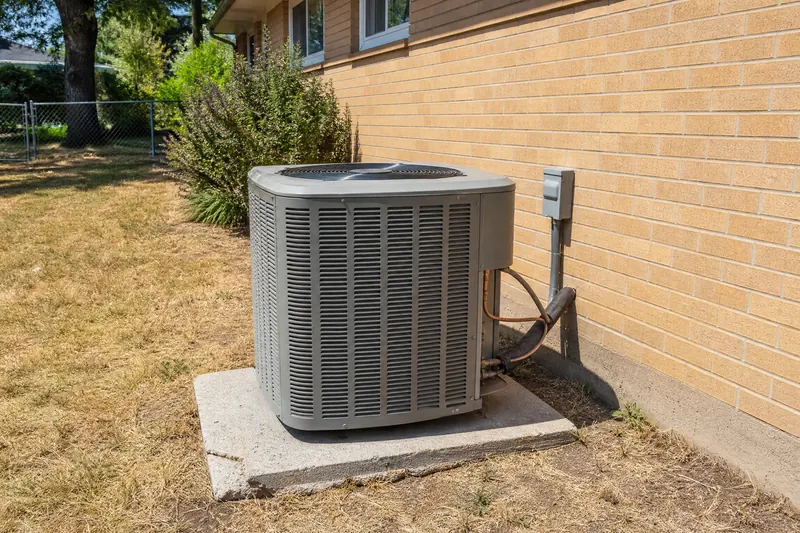
Late on a July afternoon in a brick ranch in Aurora, the box on the roof hums, a ceiling grille in the hallway breathes cool, faintly damp air, and every window on the shady side of the house is propped open a few inches. Across the street, a newer two-story house is sealed tight, its condenser droning on a concrete pad by the side fence. Both houses are comfortable. They got there in opposite ways.
That is the real choice behind the swamp cooler or central air question on the Front Range. An evaporative cooler is a fan blowing outdoor air through wet pads; it works because the air here is dry, and it costs far less to run. Central air, and its two-way cousin the heat pump, moves heat out of a closed house with refrigerant and recirculates the same indoor air. One trades on our climate. The other ignores it.
The short version: in a single-story house that already has a roof cooler and a ceiling duct, and in a household that does not mind open windows, a well-kept swamp cooler is hard to beat on running cost. Where summer smoke, ozone alerts, allergies or a second floor are part of the picture, or where an old furnace is also due, central air or a heat pump earns its higher price. Plenty of Front Range houses end up with both.
Part 1Why does a wet pad work so well here?
Evaporation pulls heat out of air, and it does that fastest when the air is thirsty. The Colorado Climate Center puts it plainly: "Humidity is generally quite low; this favors rapid evaporation and a relatively comfortable feeling even on hot days," as its Climate of Colorado overview says. Denver sits in IECC climate zone 5B, and the B stands for dry.
The Department of Energy's Energy Saver page on evaporative coolers says the pads can drop the air temperature by 15 to 40°F before it reaches the rooms. It is just as clear about the limit: these units only suit low-humidity areas, because they add moisture to the house. In a muggy climate they make things worse. Here they mostly make things pleasant.
Two-stage coolers, the newer and more efficient design, add less humidity than single-stage units, according to the same DOE page. That matters on the rare sticky days when a thunderstorm has wet the ground and the old single-stage box starts to feel clammy.
Part 2What does central air do that a cooler can't?
A central air conditioner does not care how dry the air is. It pulls heat out of indoor air at a coil, pumps it outdoors through refrigerant lines and sends the same air back through the ducts. DOE notes the key trade-off on its cooler page: an evaporative unit cannot cool a house as low as an air conditioner can.
Most of the time on the Front Range that gap is small, because the nights are cool. At the airport out east, NOAA's thirty-year averages (1991–2020) give a July high of 89.9°F against a low of 60.2°F, with about 46 days a year reaching 90°F or more. A cooler working on that dry afternoon air handles most of those days. On a record-type day, the kind that hit 105°F in July 2005 according to NWS Boulder's July records, the refrigerant system keeps going where the pad runs out of room.
Central air also keeps windows shut, which is the whole point for some households. Pollen, street noise, smoke and ozone stay outside, or at least mostly outside, and the furnace filter cleans what circulates. New equipment has to meet the national minimum, which in Colorado is 13.4 SEER2 for a split-system air conditioner; there is no separate, stricter regional number for this state.
Part 3Where does a heat pump fit in?
A heat pump is central air with a reversing valve. In summer it cools exactly like an air conditioner; in winter it runs backward and heats the house. If the furnace in the basement is near the end of its life, the cooling decision and the heating decision become one decision, and that is where a heat pump starts to make sense. The trade-offs on the heating side, cold snaps and backup heat included, are covered in our piece on furnaces and heat pumps.
Money tilts the same way. Xcel's current Colorado summary, dated effective Oct. 1, 2026, has no rebate for a stand-alone central air conditioner. It does list ducted air-source heat pumps at $600 per cooling ton at 95°F for the bonus rate and $300 standard, with bonus rates not paid where the existing main heat is already electric. These were checked October 31, 2026; Xcel changes these yearly, so confirm before you sign. Installs must be finished by Dec. 31, 2026. The details are in our guide to Xcel rebates.
The state adds a smaller sweetener. For 2026 installs, Colorado's heat pump tax credit is $1,000 for an air-source system; a registered installer claims it and has to hand at least $333 back on your bill, per the Colorado Energy Office. The old federal credits do not cover equipment put in after Dec. 31, 2025, as the IRS confirms. Our tax-credit piece explains what is left.
Part 4Running costs, water and the roof
DOE's figures are the headline for coolers: about half the installed cost of central air and about one-quarter of the energy. On an Xcel bill through a long July, that difference is real. Xcel also pays evaporative cooler rebates to its electric customers: $300 for a standard unit of 2,500 cfm or more, $675 for a premium unit with 85% media saturation, a purge pump and a thermostat, and $1,200 for a multi-ducted premium system with at least three ducts. Same caveat: checked October 31, 2026, and Xcel revises these every year.
Cooler energy and install cost against central air
percent of central air
The savings come with chores. A cooler uses water continuously, and DOE gives no gallons figure, so treat any number you hear with suspicion. Pads need checking monthly in heavy use and replacing at least twice a season. Minerals left behind by evaporation build scale, which is why coolers have a bleed line or a purge pump. Front Range tap water is not gentle on them: Denver Water reports a 2025 average hardness of about 105 mg/L and says its water tends to form scale, and Aurora's 2025 average was about 136 mg/L.
Then there is the roof. DOE warns that routine upkeep on roof units may need a ladder and can wear the roofing. Spring start-up and fall shutdown are not optional, and anyone who is not comfortable on a ladder will be paying someone twice a year. Our cooler start-up and shutdown guide walks through what the owner manuals allow a homeowner to do and what to hand off.
A central system has its own upkeep: a filter to check monthly, a spring check-up from a contractor and an outdoor unit that is exposed to Front Range hail. What to do when hail hits the condenser is its own story.
Part 5Open windows, smoke and ozone days
A cooler only works with somewhere for the air to go. DOE says to open windows or vents on the downwind side of the house, about 1 to 2 square feet of opening for every 1,000 cfm of cooler capacity. Open them too wide and hot air pours in; too little and humidity builds indoors. Houses with up-ducts exhaust into the attic instead, and those need extra attic ventilation.
That constant stream of outdoor air is the cooler's charm and its weak point. On smoky days, when fires to the west turn the afternoon sun orange, turn the cooler off or run it sparingly. EPA's wildfire indoor air guidance asks owners to cover the outside air intakes completely with 4-inch-thick MERV 13 furnace filters, and where that can't be done, to use the cooler sparingly because it can bring more smoke inside. Most households simply switch it off and close up. Our smoke and filter guide covers the rest.
Ozone is different: it is a gas, not a particle, so no filter over the pads catches it. On an Ozone Action Day, a cooler pulls in whatever ozone is in the outdoor air. The practical answer is to run it hard in the cool morning and evening, then ease off in the heat of the afternoon if anyone at home has asthma or other lung trouble. Our ozone day guide explains why the timing matters. A central system can stay on recirculate with the windows shut through both kinds of day, which is the single biggest reason some cooler owners switch.
Part 6Which houses suit which system?
The 1950s to 1970s ranches of Aurora, Lakewood, Arvada and Westminster were practically built for the roof cooler. One story, a central hallway grille, short runs and a roof a homeowner can see from the ground. If that cooler is healthy and nobody minds the open windows, there is no strong case for tearing it out.
Two-story suburbs are harder. A single ceiling grille upstairs or down rarely reaches the far rooms, and heat collects on the second floor whatever system you have; our piece on hot upstairs rooms gets into why. Houses with existing supply ducts are natural candidates for central air or a ducted heat pump.
The brick bungalows and Denver squares closer to downtown often have boilers or old gravity ducts and no practical path for new ductwork. For them the realistic alternative to a window unit or a roof cooler is ductless; our ductless guide for older Denver houses looks at where heads go and what installs involve.
Some households keep both: the cooler for most of the summer, central air for smoky weeks and the hottest days. It costs more up front but gives you a choice on each kind of day.
Part 7Permits, contractors and the paperwork
Whichever way you go, a replacement is permitted work. Denver lets single-family and duplex owners use a quick permit for replacement air conditioners and evaporative coolers, and inspectors check that new equipment meets current efficiency, as of the city's pages we could read in 2026. Aurora's homeowner handbook lists both central air and swamp coolers as needing a permit every time. A homeowner can pull a Denver mechanical permit only on an owner-occupied single-family house and only after passing the city's exam; otherwise the contractor pulls it.
Ask for a written bid that names the equipment, its SEER2 rating, who pulls the permit and who applies for any rebate. Our permits guide and the piece on choosing a contractor go further. If you are unsure whether the ducts, the electrical service or the roof can handle what is proposed, ask a licensed pro before you sign.
Common questions
Can a swamp cooler and central air share the same ducts in a Denver house?
Sometimes, but it is a design job, not a homeowner swap. A cooler moves a large volume of outdoor air and needs relief openings, while central air recirculates through a sealed system. A licensed contractor has to work out dampers and sizing so one does not undo the other.
Will a swamp cooler keep up on a 100-degree Front Range day?
DOE says a cooler can drop incoming air 15 to 40°F, and it never cools as low as an air conditioner. On the hottest afternoons a cooler house will feel warmer than an air-conditioned one, though the dry air helps it feel tolerable. The cool nights let it catch up.
Does Xcel give a rebate for replacing an old swamp cooler with central air?
Not for a stand-alone air conditioner, according to the 2026 summary checked October 31, 2026. Xcel does list rebates for heat pumps and for new evaporative coolers. Confirm current amounts with Xcel before you sign anything.
Is a two-stage evaporative cooler worth it in Denver?
DOE describes two-stage coolers as more efficient and says they add less humidity than single-stage units. That helps on muggier storm days and in tighter houses. Whether the price difference pays back depends on the unit and the house, so get it quoted side by side.
Should a swamp cooler run on a smoky or ozone alert day?
On smoky days, turn it off or run it sparingly unless every outdoor intake is covered by 4-inch MERV 13 filters, per EPA. On ozone days, run it in the cool morning and evening and ease off in the afternoon heat. Neither problem goes away just because the pads are wet.
Sources
- DOE Energy Saver — Evaporative Coolers — temperature drop, energy and install cost, open windows, pads, two-stage coolers, drawbacks
- Colorado Climate Center — Climate of Colorado — low humidity and rapid evaporation
- NOAA NCEI — Denver 2023 Local Climatological Data annual summary — July normal high and low, days at 90°F or more
- NWS Boulder — Denver July climate records — the 105°F July record
- eCFR — 10 CFR 430.32 energy conservation standards — 13.4 SEER2 minimum for split air conditioners
- EPA — Wildfires and Indoor Air Quality — evaporative coolers in smoke, MERV 13 intake filters
- Colorado Energy Office — HPTC program page — 2026 contractor-claimed credit and minimum discount
- IRS — Energy Efficient Home Improvement Credit — federal credit ended for 2026 installs
- Xcel Energy Colorado — Heat pumps and rebate summary — heat pump and evaporative cooler rebates, install and application dates
- Denver Water — Water hardness — scale-forming water
- ICC — 2012 IECC climate zone table — Denver in climate zone 5B